Full-Grain Leather
Corrected-Grain Leather
Corrected-Grain Leather

Full-grain leather retains the original grain surface of the hide rather than being buffed to remove its natural markings. Its visible character may include pores, grain variation, wrinkles and healed surface marks.
Depending on its tannage and finish, full-grain leather may be soft and supple or firm and structured, with surfaces ranging from natural and matt to more protected finishes. It is commonly used for footwear, bags, belts and other leather goods where natural character and ageing are part of the intended result.
The term “full-grain” describes the condition of the surface; it does not, by itself, determine the grade or suitability of a particular leather.
Corrected-Grain Leather
Corrected-Grain Leather
Corrected-Grain Leather
Corrected-grain leather has been buffed or lightly abraded to reduce visible surface irregularities. Pigments, coatings or an embossed grain may then be applied to create a more uniform colour and appearance.
This can be useful for products or commercial ranges requiring greater visual consistency. However, the degree of correction and thickness of the surface finish can vary considerably.
Flexibility, crease behaviour and finish adhesion should therefore be evaluated in relation to the intended product and construction.
Suede
Corrected-Grain Leather
Nubuck
Suede has a soft, fibrous surface created by abrading the flesh side of the hide or a split layer of leather.
Its raised nap gives the material a warm, tactile appearance. Because the direction of the nap reflects light differently, the colour may appear lighter or darker when viewed or brushed from different angles.
Thickness, strength, nap consistency, colour fastness and reinforcement requirements should be considered when selecting suede for footwear, bags or other leather goods.
Nubuck
Embossed and Printed Leather
Nubuck
Nubuck is produced by lightly abrading the grain surface of the leather to create a fine, velvety nap. Compared with suede, its nap is generally shorter and more subtle.
The surface may show tonal movement when touched or brushed and can develop marks through handling and wear.
These characteristics contribute to its natural appearance but should be considered in relation to the product’s intended use, performance and care requirements.
Pull-Up and Waxed Leather
Embossed and Printed Leather
Embossed and Printed Leather
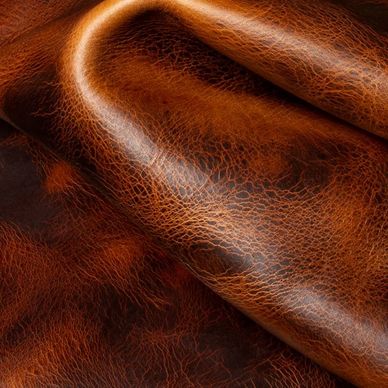
Pull-up and waxed leathers are treated with oils, waxes or both. When the leather is folded, stretched or handled, these substances move within the material and create lighter tonal areas.
Creases, marks and colour movement are part of the intended character of this type of leather rather than signs of damage. Pull-up effects are frequently used for boots, casual footwear, bags and accessories intended to develop a richer patina through use.
Shade variation, cutting placement and the expected movement of oils or waxes should be considered during development.
Embossed and Printed Leather
Embossed and Printed Leather
Embossed and Printed Leather
Embossing uses pressure, and often heat, to create a pattern or texture on the leather surface. It may produce pebbled, geometric, reptile-inspired or other decorative effects. Printing can introduce colour, imagery, pattern or additional visual depth.
Pattern scale, direction, repetition and alignment should be considered during cutting and assembly. The material must also be assessed for possible distortion when it is folded, stitched or lasted over a three-dimensional form.
The clarity and depth of an embossed or printed finish may vary between hides and production batches.
Patent and Coated Leather
Patent and Coated Leather
Patent and Coated Leather
Patent leather has a sealed, high-gloss surface, while other coated leathers may range from softly polished to matt, metallic or highly reflective finishes.
These treatments can create a distinctive formal or fashion-led appearance, but the coating may influence flexibility, breathability, adhesion and crease behaviour. The material should therefore be tested for compatibility with the intended construction, finishing process and use.
Specialist Leathers
Patent and Coated Leather
Patent and Coated Leather
Specialist materials may include hair-on hides, metallic, distressed or perforated leathers, exotic and exotic-effect surfaces, two-tone treatments and other bespoke finishes.
Each material should be evaluated individually according to its thickness, structure, usable cutting area, pattern direction, symmetry, reinforcement requirements and expected performance.
Availability, consistency, minimum quantities, lead times and any relevant sourcing or documentation requirements will depend on the particular material and project.